The History of Tattoo Flash: From Sailors to Digital Discovery

From sailors' superstitions to flash sheets on shop walls and digital discovery: how tattoo flash shaped the way people choose their tattoos.
Before Instagram, before online portfolios and before tattoo artists could share their work with the entire world, there was a wall.
Inside tattoo shops, sheets of drawings displayed everything from anchors and eagles to roses, skulls, pin-up girls and mythical creatures. Clients would look through them, choose a design and decide what they wanted to carry on their skin.
These drawings were known as tattoo flash. They became one of the most recognisable parts of traditional tattoo culture. But their history is about much more than ready-made designs. It involves sailors, travelling artists, commercial ingenuity and a visual language that travelled across oceans.
Sailors, superstitions and stories on skin
Long before tattoo flash sheets became common in American studios, sailors were already carrying a recognisable collection of symbols.
An anchor could represent a connection to the sea. A ship could commemorate a difficult voyage. A swallow traditionally represented 5,000 nautical miles travelled, meaning that two swallows could mark 10,000 miles at sea.
Some symbols had stranger origins. The pig and rooster tattoo is one of the most unusual examples. Sailors sometimes placed a pig on one foot and a rooster on the other, believing the images would protect them from drowning.
According to the U.S. Navy's heritage pages, the superstition may go back to the age of sail, when pigs and roosters were carried aboard ships in wooden crates. If a vessel sank, the crates could float, making the animals among the few survivors. It is a folk explanation rather than a documented fact, but the tattoo became a kind of lucky charm. [1]
These designs were not simply decorative. They communicated experience, identity, belief and sometimes a sailor's entire relationship with the sea.
As ships moved between ports, tattoo traditions moved with them.
When tattoo designs became a business
By the late nineteenth and early twentieth centuries, professional tattooing was developing in port cities and commercial studios.
One of the people associated with the development and distribution of tattoo flash was Lewis Alberts, often known as "Lew the Jew". His drawings and printed sheets helped make designs available to tattooers beyond their own studios. Sources differ on exactly when his flash sheets first appeared, but his role in spreading them is widely recognised.
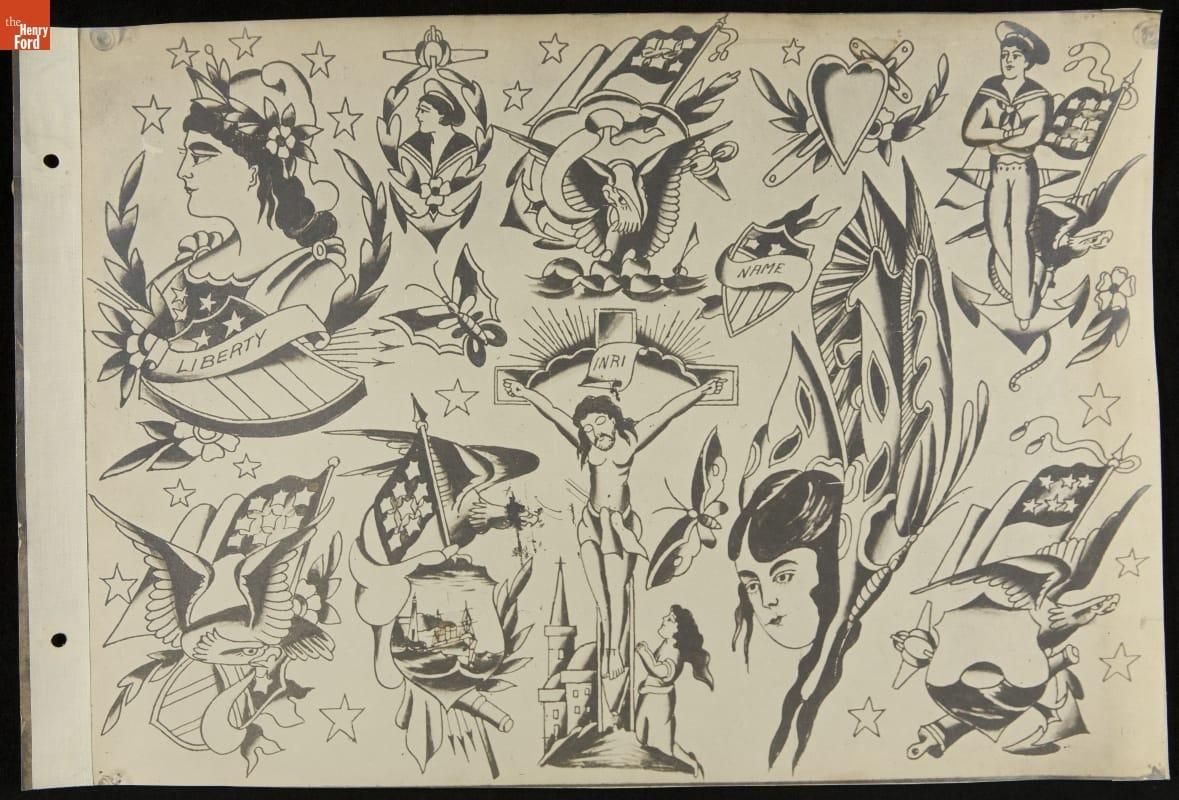
Instead of every artist having to create every design from scratch, flash sheets could be purchased, displayed and reused. Tattooers could also exchange designs, expanding the selection available to their customers.
This created something close to an early visual network between tattoo studios.
There was a practical reason behind it. Many customers, particularly sailors, had limited time in port. A wall full of ready-made designs allowed them to choose quickly instead of spending hours discussing a completely custom image.
The system also made tattooing more accessible to artists who wanted to establish a business without producing an entire catalogue themselves. [2]
Percy Waters and a glimpse inside a tattooer's mind
One of the most fascinating historical collections belongs to Percy Waters, a Detroit tattoo artist who worked in the early twentieth century.
The Henry Ford museum preserves an extraordinary collection of his materials. Among them is a flash portfolio containing approximately 277 full-colour watercolor designs, alongside original sketches.
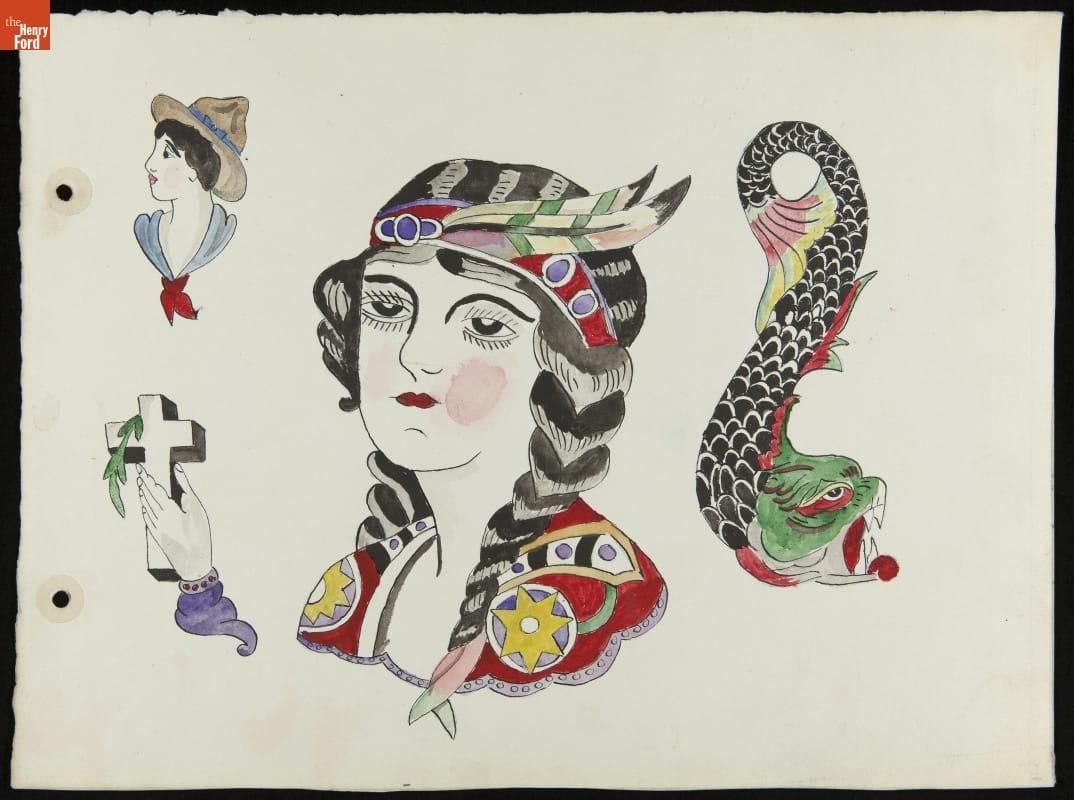
The drawings include flowers, hearts, sailing ships, portraits, animals, dragons, religious figures and good-luck symbols. Some are familiar traditional tattoo subjects; others reflect the popular culture and imagination of the period.
What makes the collection particularly interesting is that it offers a glimpse of how a tattooer worked: from the first ideas on paper to the polished designs presented to customers. It shows tattooing developing into a professional trade, with its own visual culture. [3]
Cap Coleman and the tattoo shop as a gallery
Another important figure was August "Cap" Coleman, who opened his tattoo shop in Norfolk, Virginia, around 1918.
Norfolk was a busy port, making it a natural location for a tattoo business serving sailors and other travellers.
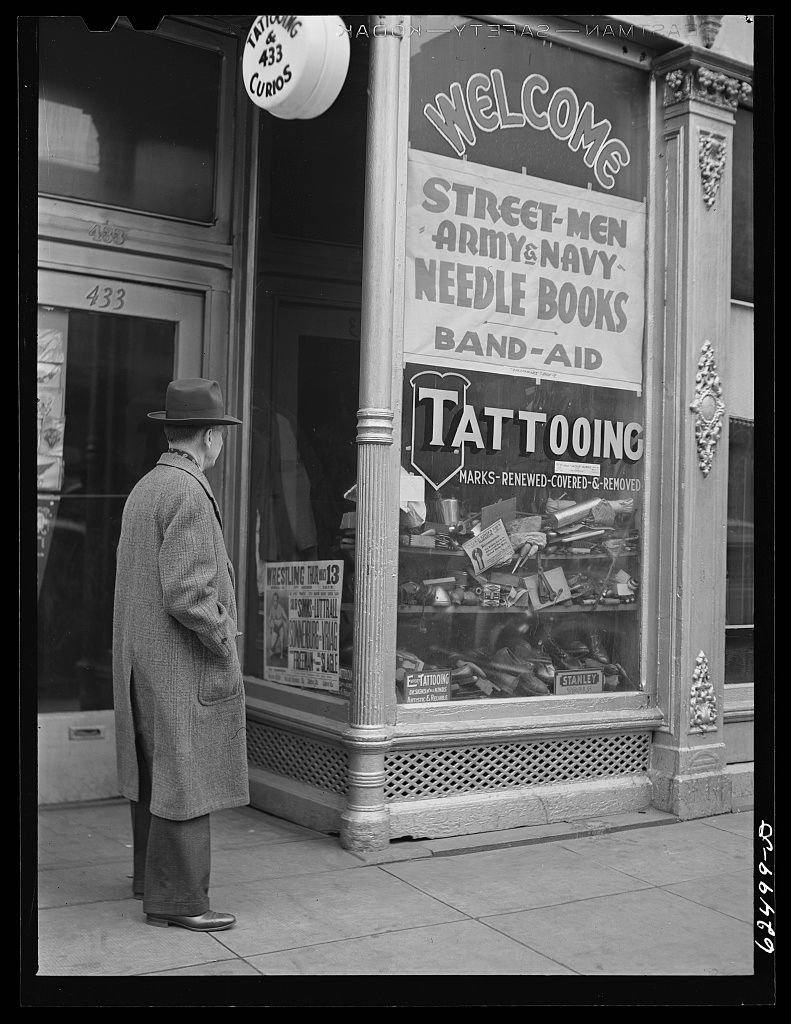
Tattoo parlor on West Main Street, Norfolk, Virginia, 1941. Photo: John Vachon, Library of Congress.
Coleman's work is preserved at The Mariners' Museum. One particularly interesting piece is a large watercolor sheet commissioned by the museum in 1936, titled Designs of the Tattooers Art. The museum also holds photographs of his storefront from the same year, with its windows covered in flash sheets. In other words, tattooers were already using visual merchandising to attract customers long before social media existed.
Coleman's career also reflects how vulnerable tattoo businesses could be to local regulations. After the Second World War, Norfolk prohibited tattooing, and Coleman and other tattooers were forced to leave the city. [4]
From the wall to the phone
For decades, flash sheets were central to the way tattoo shops presented their work. They were displayed on walls, traded between artists and sometimes collected as original artwork.
Today, tattoo discovery happens differently. People browse Instagram, digital portfolios and online platforms, often looking for a specific style or artist before making contact.
But the underlying idea has not disappeared: people still discover tattoos by looking at designs.
InklouMatch brings that tradition into a digital environment through Match by Flash. Clients can explore flash designs by city, mark the ones they like and discover tattoo artists connected to those designs.
Instead of choosing from a sheet on a studio wall, the client can now discover work from different artists and find someone whose visual style matches their interests.
The technology has changed, but the relationship remains familiar. A drawing catches someone's attention, creates an interest in a particular artist and can become the starting point for a tattoo.
From Percy Waters' watercolor sketches to digital flash collections, the history of tattoo flash is also the history of how artists make their work visible.
The wall has become a screen. The connection between the drawing, the artist and the person who wears it is still at the centre of tattoo culture.
Sources
1. U.S. Naval History and Heritage Command, "Sailors' Tattoos" (history.navy.mil, Customs and Traditions).
2. Tattoo Archive, "Lewis 'Lew the Jew' Alberts" (tattooarchive.com/history/alberts_lew_the_jew.php).
3. The Henry Ford, "An Artist with the Needles" (thehenryford.org/collections/explore/articles/tatoo-history-at-thf).
4. The Mariners' Museum, Designs of the Tattooers Art, August "Cap" Coleman, 1936, accession 1936.166.20 (marinersmuseum.org/2020/10/tattooinga-dead-art/).